Indianz.Com > News > ‘A historic day’: #MMIW legislation finally signed into law
‘A historic day’: #MMIW legislation finally signed into law
Monday, October 12, 2020
Indianz.Com
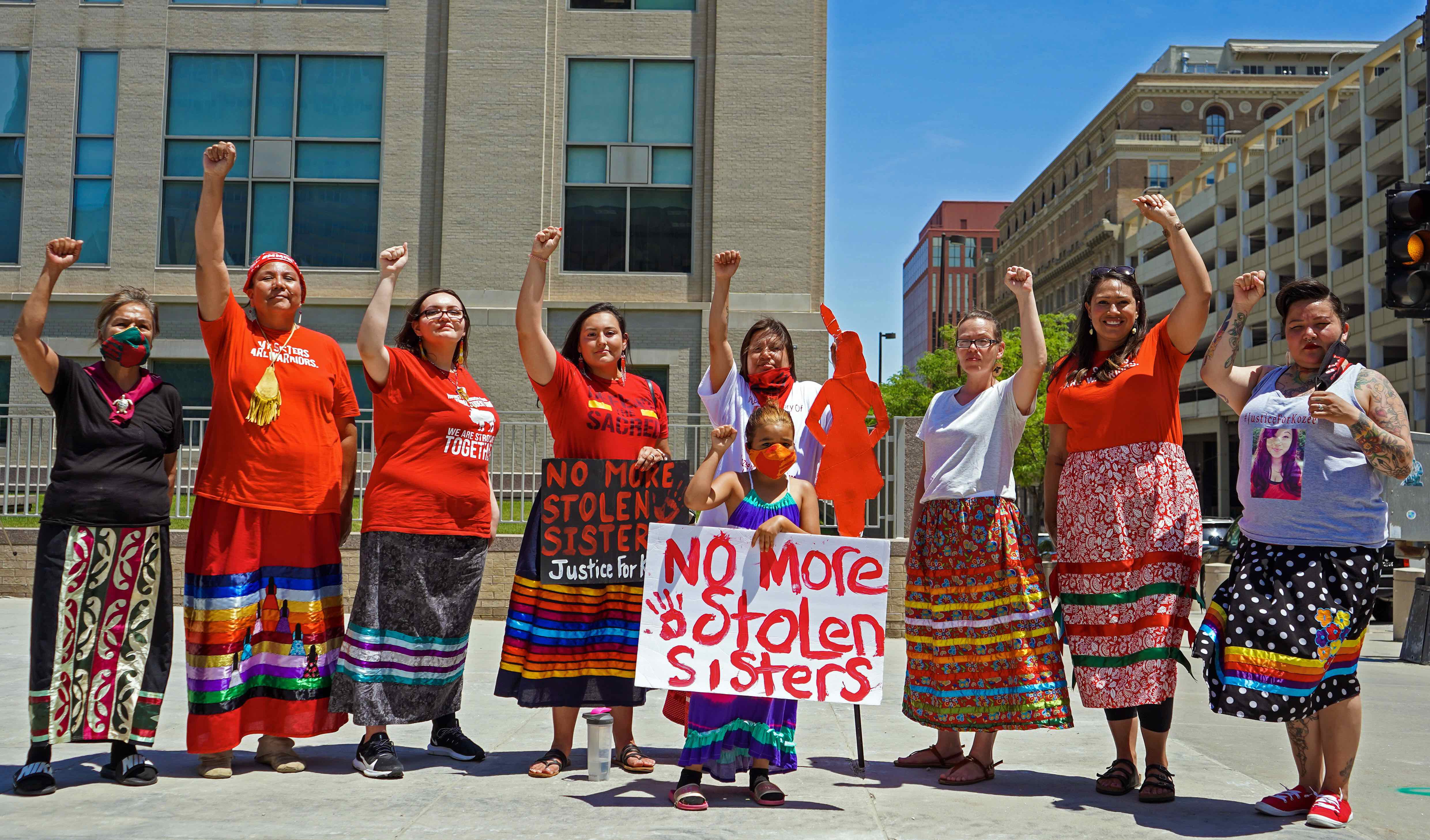
It took years of work by Native women and activists but legislation to address the crisis of missing and murdered sisters and relatives has finally become law.
Just in time for Indigenous Peoples Day, President Donald Trump signed S.227, Savanna’s Act, and S.982, the Not Invisible Act, into law on Saturday. The bipartisan measures mark the first time in which the federal government, as a whole, will be required to account for missing and murdered Native people, especially women and girls.
“Everyone in this country deserves to feel safe in their communities, but a long history of violence against Native people has led to the disappearance and murder of Native Americans at alarming rates,” said Rep. Deb Haaland (D-New Mexico), a citizen of the Pueblo of Laguna and one of the first two Native women to serve in Congress.
“Today, we celebrate two huge steps to combat the missing and murdered indigenous women’s crisis, an effort led by survivors, activists, and Native women across the country,” Haaland said after Trump signed S.227 and S.982, 10 days following their presentation to the president.


• S.209, the Practical Reforms and Other Goals To Reinforce the Effectiveness of Self-Governance and Self-Determination (PROGRESS) for Indian Tribes Act. The bill brings long-overdue reforms to the self-governance programs at the Department of the Interior and at the Department of Health and Human Services.
• S.294, the Native American Business Incubators Program Act.
The bill creates a new program at the Department of the Interior to boost entrepreneurship and economic development in Indian Country, where unique legal and policy challenges, along with limited infrastructure, hinder growth.
• S.832, a bill to nullify a “supplemental treaty” that some citizens of the Warm Springs Tribes were forced to sign back in 1865, amid pressure from non-Indian settlers. The agreement, which has been disavowed by the tribe and the state of Oregon, attempts to limit the rights of the Warm Springs people.
Prior to S.227 and S.982, the following three bills were signed into law, back in December 2019:
•
S.256, the Esther Martinez Native American Languages Programs Reauthorization Act. The new law reverses decades of federal policy in which Native Americans were discouraged or prevented from speaking their own languages.
• S.50, the Columbia River In-Lieu and Treaty Fishing Access Sites Improvement Act. The new law fulfills a promise made in tribal treaties to maintain fishing sites and villages along the Columbia River in Washington and Oregon.
• S.216, the Spokane Tribe of Indians of the Spokane Reservation Equitable Compensation Act. The new law compensates the Spokane Tribe for the loss of its lands to the Grand Coulee Dam in Washington state.
Separately, Trump in December 2019 signed a national defense bill that included provisions to extend federal recognition to the Little Shell Tribe of Chippewa Indians, headquartered in Montana. The package also restored homelands to the Lytton Band of Pomo Indians and the Santa Ynez Band of Chumash Indians, both in California.
Assuming Trump signs S.209, S.294 and S.823, tribes will have seen eleven substantive Indian Country measures become law during the 116th Congress. The session concludes in December, but with the election fast approaching, there are fewer and fewer opportunities for the list to grow.
Operation Lady Justice
c/o Executive Director Marcia Good
Office of Justice Programs, Room 6336
U.S. Department of Justice
810 7th Street NW
Washington DC 20531
During the first listening session of the Operation Lady Justice task force in February, tribal leaders called on the Trump administration to change the structure of the body to ensure their input was considered in a manner consistent with the government-to-government relationship. Although officials said they were looking at ways of including more voices through advisory or working groups, the suggestion was never fully implemented.
c/o Executive Director Marcia Good
Office of Justice Programs, Room 6336
U.S. Department of Justice
810 7th Street NW
Washington DC 20531
Search
Filed Under
Tags
More Headlines
Testimony: Stephanie Bryan, Poarch Band of Creek Indians
Testimony: Michell Hicks, Eastern Band of Cherokee Indians
Testimony: Mark Macarro, Pechanga Band of Indians
Testimony: Patricia Leach, Catawba Nation
Testimony: Bryan Mercier, Bureau of Indian Affairs
Senate Committee on Indian Affairs holds business meeting and legislative hearing
Native America Calling: How Indigenous voices adapt to rapidly-evolving media
Native America Calling: PBS documentary ‘Knowledge Keepers’ explores Native scientific innovations
Testimony: Alicia Puente Cackley, Government Accountability Office
Testimony: Hilary Atkin, Department of Housing and Urban Development
Testimony: Bryan Warner, Cherokee Nation
VIDEO: H.R.741 – Stronger Engagement for Indian Health Needs Act of 2025
VIDEO: H.R.6021 – Archie Cavanaugh Migratory Bird Treaty Clarification Act
Senate Committee on Indian Affairs takes up Native housing
Native America Calling: Native advocates assess barriers to upcoming elections
More Headlines
Testimony: Michell Hicks, Eastern Band of Cherokee Indians
Testimony: Mark Macarro, Pechanga Band of Indians
Testimony: Patricia Leach, Catawba Nation
Testimony: Bryan Mercier, Bureau of Indian Affairs
Senate Committee on Indian Affairs holds business meeting and legislative hearing
Native America Calling: How Indigenous voices adapt to rapidly-evolving media
Native America Calling: PBS documentary ‘Knowledge Keepers’ explores Native scientific innovations
Testimony: Alicia Puente Cackley, Government Accountability Office
Testimony: Hilary Atkin, Department of Housing and Urban Development
Testimony: Bryan Warner, Cherokee Nation
VIDEO: H.R.741 – Stronger Engagement for Indian Health Needs Act of 2025
VIDEO: H.R.6021 – Archie Cavanaugh Migratory Bird Treaty Clarification Act
Senate Committee on Indian Affairs takes up Native housing
Native America Calling: Native advocates assess barriers to upcoming elections
More Headlines