Indianz.Com > News > Cronkite News: New law protects tribal regalia at school graduations

 YouTube
 Arizona law allows Indigenous students greater cultural expression at graduation
Wednesday, November 24, 2021
Cronkite News
PHOENIX, Arizona — Just minutes before her high school graduation in Gallup, New Mexico, three years ago, Dakotah Harvey was told to remove the eagle feather from her mortarboard or she would be escorted out of the ceremony and her diploma would be withheld.
Her grandfather had tied the feather to the cap’s tassel earlier that day, Harvey told Cronkite News. He loaned it to her after performing a Navajo prayer in celebration of her achievement.
“I didn’t have the heart to tell him I couldn’t wear it,” Harvey said.


 www.facebook.com
 Arizona law allows Indigenous regalia
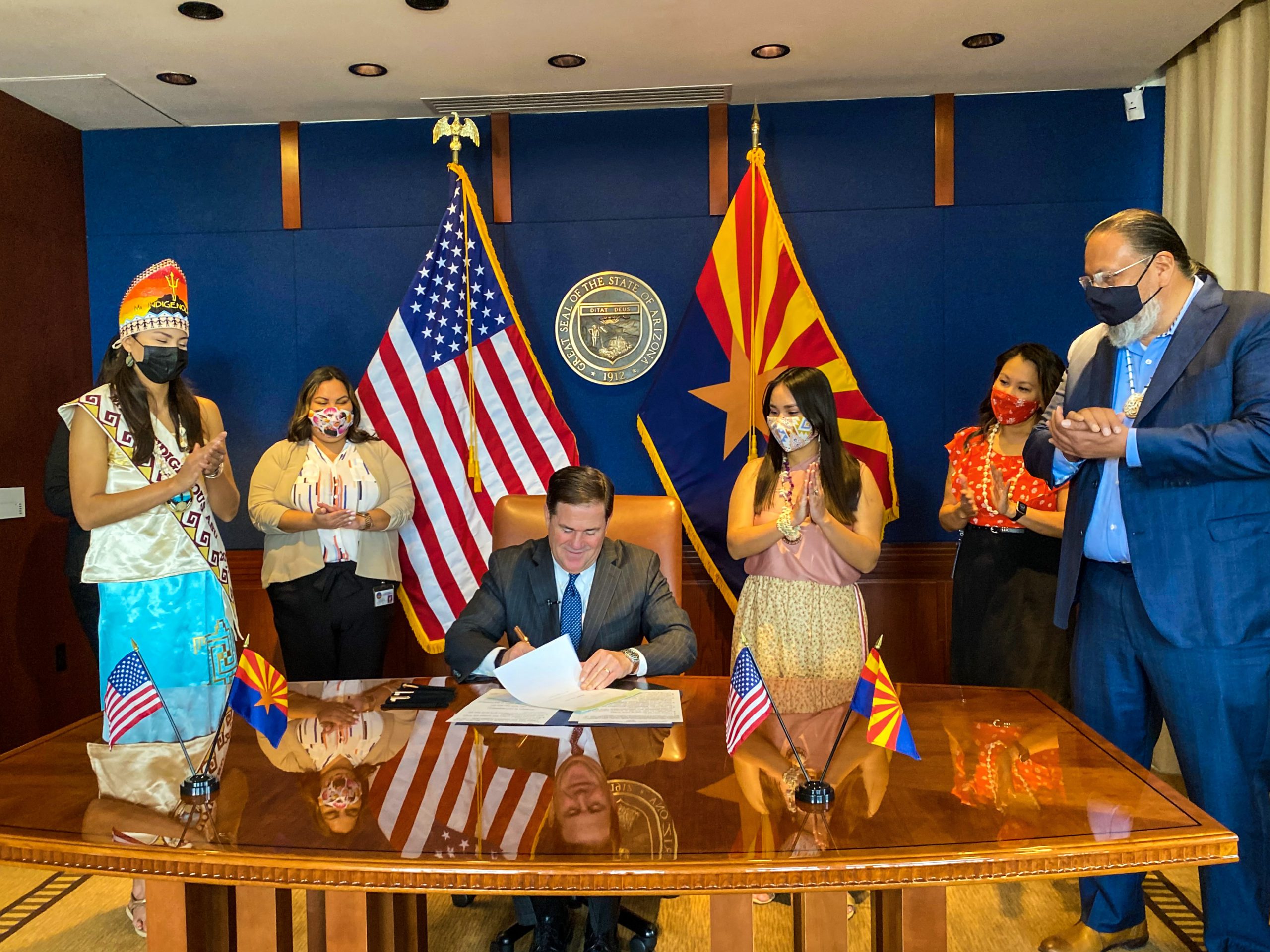
The Arizona bill, House Bill 2705, was introduced in early 2021 by Rep. Arlando Teller, D-Chinle, who later resigned from the Legislature to work for the U.S. Department of Transportation. The bill was championed by Rep. Jasmin Blackwater-Nygren, D-Red Mesa, a fellow Navajo, and passed in April.
At the Capitol on September 1, Lourdes Pereira, who is Hia-Ced O’odham and Miss Indigenous Arizona State University for 2020-21, stood at Ducey’s side as he signed legislation that included HB 2705.
In 2018, Pereira and fellow Pueblo High School graduate Maddy Jeans, who is Navajo, Pascua Yaqui and Otoe, successfully fought to change Tucson Unified School District policy to allow Indigenous students to wear cultural regalia at graduation. Previously, special permission was required.
Similar laws exist in California and Montana, and Utah lawmakers recently introduced similar legislation.
“Graduation is a milestone and is a ceremony,” said Jolyana Begay-Kroupa, Phoenix Indian Center director of development and Navajo language professor at Arizona State University.
The use of feathers and other cultural regalia is important to many tribes in celebrating significant points in life, she said, and it serves as a reminder to everyone that “we’re still here.”
Begay-Kroupa hopes the new law will prompt discussions that lead to better understanding between cultures.
Harvey, who’s now studying at ASU, wished more students and parents had advocated for a better, more inclusive graduation dress code.
“I think at the time we were just like, ‘You know what, we’re almost done with high school, we’re going to suck it up through the ceremony and just get through it and then we’re booking it out of here,’” she said.

Regalia allows for greater cultural expression
Such rules and policies can make it more difficult to celebrate milestones in culturally relevant ways within schools and make it harder to be Indigenous, especially for those living near towns bordering reservations.
Gallup is outside the southeastern border of the Navajo Nation Reservation in New Mexico and serves as a hub for commerce and education, which much of the reservation lacks.
Other Navajo Nation border towns are Flagstaff and Holbrook, as well as Farmington, New Mexico.
A life of commuting from the city to the reservation is common around these towns, which can have stark cultural differences.
“I know a lot of kids who struggled with trying to be a city kid, or a suburban kid, or a Native kid and they would struggle back and forth,” Harvey said.
Harvey hopes New Mexico adopts a similar law, which would support freer cultural expression and alleviate some of those struggles. She doesn’t want her younger siblings to endure what she did when they walk across the graduation stage.
For more stories from Cronkite News, visit cronkitenews.azpbs.org.
Note: This story originally appeared on Cronkite News. It is published via a Creative Commons license. Cronkite News is produced by the Walter Cronkite School of Journalism and Mass Communication at Arizona State University.
Search
Filed Under
Tags
More Headlines
Testimony: Alicia Puente Cackley, Government Accountability Office
Testimony: Hilary Atkin, Department of Housing and Urban Development
Testimony: Bryan Warner, Cherokee Nation
VIDEO: H.R.741 – Stronger Engagement for Indian Health Needs Act of 2025
VIDEO: H.R.6021 – Archie Cavanaugh Migratory Bird Treaty Clarification Act
Senate Committee on Indian Affairs takes up Native housing
Native America Calling: Native advocates assess barriers to upcoming elections
Native America Calling: An Indigenous-led opera retells a historic Tlingit act of resistance
Native America Calling: Shifting preservation policies pose risks to Native history
Chuck Hoskin: Cherokee Nation makes tribal government easy to reach
Native America Calling: Persistent heat puts strain on people, the environment, and the economy
Chuck Hoskin: Cherokee Nation creates opportunities close to home
Native America Calling: Increasing hurdles and uncertainty put strains on Native beef producers and farmers
Chuck Hoskin: Cherokee Nation keeps our language alive
‘Let’s go’: Peggy Flanagan wins Democratic primary for U.S. Senate seat in Minnesota
More Headlines
Testimony: Hilary Atkin, Department of Housing and Urban Development
Testimony: Bryan Warner, Cherokee Nation
VIDEO: H.R.741 – Stronger Engagement for Indian Health Needs Act of 2025
VIDEO: H.R.6021 – Archie Cavanaugh Migratory Bird Treaty Clarification Act
Senate Committee on Indian Affairs takes up Native housing
Native America Calling: Native advocates assess barriers to upcoming elections
Native America Calling: An Indigenous-led opera retells a historic Tlingit act of resistance
Native America Calling: Shifting preservation policies pose risks to Native history
Chuck Hoskin: Cherokee Nation makes tribal government easy to reach
Native America Calling: Persistent heat puts strain on people, the environment, and the economy
Chuck Hoskin: Cherokee Nation creates opportunities close to home
Native America Calling: Increasing hurdles and uncertainty put strains on Native beef producers and farmers
Chuck Hoskin: Cherokee Nation keeps our language alive
‘Let’s go’: Peggy Flanagan wins Democratic primary for U.S. Senate seat in Minnesota
More Headlines