Indianz.Com >
News > Indian Country starts off new year with surge in COVID-19 cases

YouTube
Navajo Nation Office of the President and Vice President: COVID-19 Town Hall – January 4, 2022
Indian Country starts off new year with surge in COVID-19 cases
Thursday, January 6, 2022
By Acee Agoyo
Indianz.Com
Tribal communities across the nation are once again seeing an explosion in
COVID-19 cases following the busy holiday season and as a new and highly contagious variant brings upheaval to Indian Country.
Some tribes are reimposing lockdowns, the likes of which haven’t been seen since the onset of the coronavirus pandemic almost two years ago. Others are warning of negative impacts to their health care systems due to the
Omicron variant that is spreading quickly throughout the United States.
“Of course you know that the Omicron variant throughout the country has surpassed the Delta variant,”
President Jonathan Nez of the
Navajo Nation said during a
COVID-19 town hall on Tuesday.
“It was just our time, I guess, that Omicron is here,”
Nez said from the largest reservation in the country.
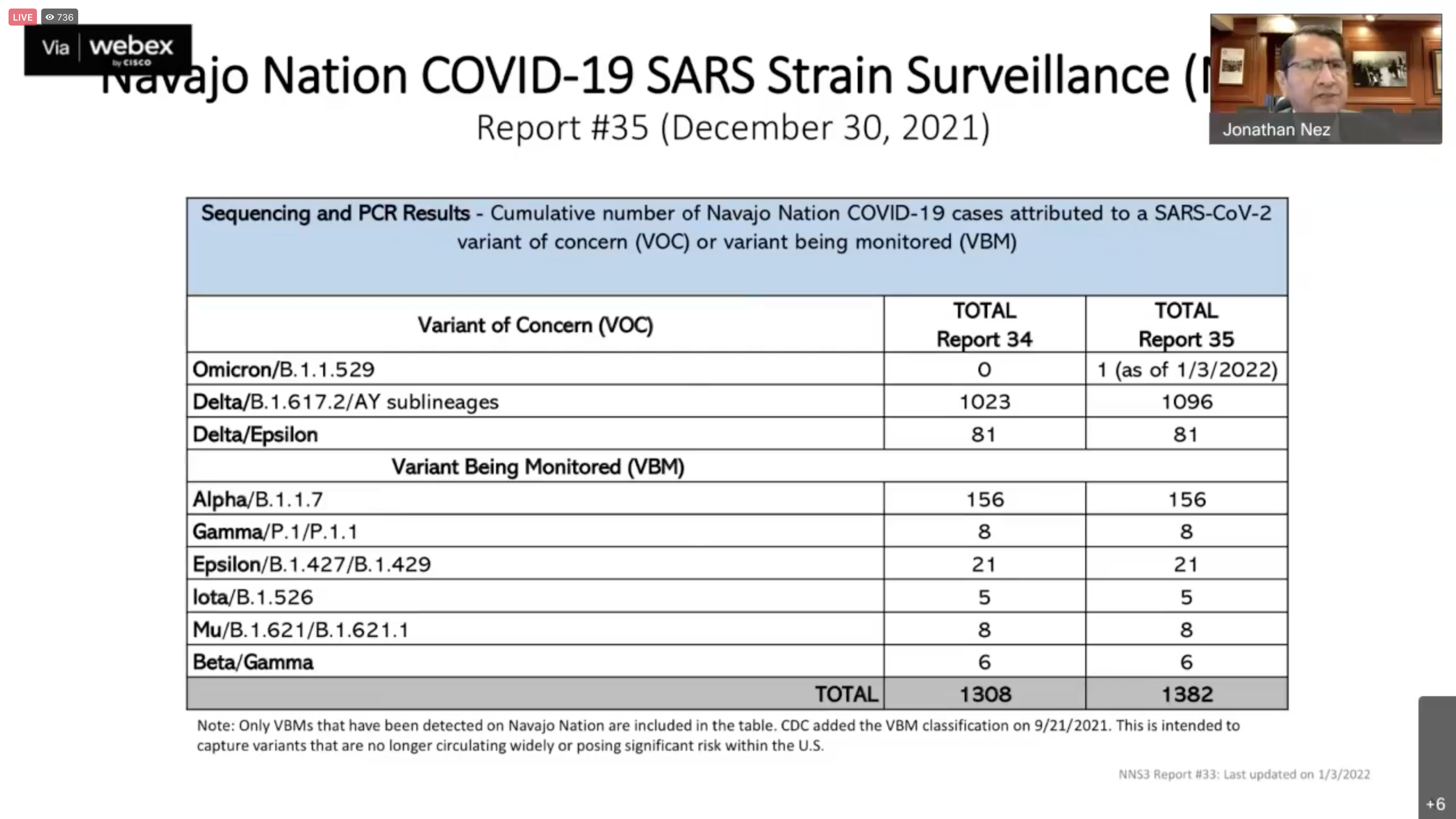 The Navajo Nation confirmed its first case of the COVID-19 Omicron variant through surveillance and sequencing of coronavirus results. Image: Navajo Nation Office of President and Vice President
The
Navajo Nation confirmed its first Omicron case on Monday, on the Utah portion of the reservation. The variant arrived despite a high COVID-19 vaccination rate — more than 72 percent of tribal citizens over the age of 12 have been fully inoculated as of Wednesday,
according to the latest data.
But strong public health measures are proving no match to the Omicron, which has contributed to sky-high infection rates across the U.S. ever since it was first confirmed on December 1.
“We did our very best,” Nez said of his tribe, one of the two largest, in terms of citizenship numbers. “We did extremely, extremely well, pushing this, keeping this variant off the Navajo Nation.”
“But it’s all around us,” Nez added, pointing COVID-19 data from the states of Arizona, New Mexico and Utah. “It’s everywhere. It’s very contagious.”

www.facebook.com
The other largest tribe is experiencing upheaval as well, reporting a shortage of
monoclonal antibody (MAB) medication, which has been used to treat COVID-19 illness in patients. Even so, the
Cherokee Nation on Wednesday warned that the treatment doesn’t appear to be as effective when it comes to Omicron.
“Current monoclonal medication studies have also been found to have limited effectiveness against infection with the Omicron variant,” a
post on social media from the 14-county reservation in northeastern Oklahoma read. “As a result, the federal government has reduced the supply of MAB to prioritize more effective treatments, and Cherokee Nation is diligently working to acquire those newer treatments as they become available.”
Other tribal communities are confronting the fallout from Christmas, when families gathered in large numbers and people traveled at levels not seen in two years. The
Pueblo of Laguna, for instance, began the first full week of 2022 on Monday by
reporting a “sudden spike in COVID-19 cases” that leadership attributed to the holiday season.
www.facebook.com
By Wednesday, the
tribe reinstated strict measures affecting travel to and from the reservation, which is located along a busy interstate, not far from the most populous city in New Mexico. Additionally, a public ceremony connected to the swearing-in of new officials at Laguna was
canceled on the eve of the annual event.
Pueblo tribes elsewhere in the state, which typically hold leadership ceremonies on January 6, also imposed
limits on public gatherings amid the coronavirus wave sweeping the nation.
And no corner of Indian Country is being spared. According to the latest data from the
Indian Health Service, COVID-19 cases have exploded dramatically — and in every region — following the Christmas holiday.
As of Wednesday, the 7-day rolling average positivity rate
climbed to a record 21.7 percent, the highest since the IHS began releasing data nearly two years ago. The rate is calculated by tallying the number of coronavirus tests that have returned positive for COVID-19 over a seven-day period.

X (formerly Twitter)
On December 25, 2021, the
7-day rate had been 9.1 percent. That means the IHS has seen a 138 percent increase in COVID-19 cases since Christmas, based on the rolling average positivity data.
Getting vaccinated remains one of the best ways to protect against COVID-19, according to public health officials. During a visit to an urban Indian provider in northern California in early December, Elizabeth Fowler, the
acting director of the IHS, said the agency was ramping up efforts to remind and encourage people to complete their dosage series and get boosted as soon as possible.
“We are doing all we can to get the word out about COVID-19 vaccine booster clinics and eligibility,” Fowler said at the
Native American Health Center in Oakland on December 7. “IHS plans to reach more than 300,000 patients at our direct care sites before the holidays.”
“We must get the word to all those who are eligible,” said Fowler, a citizen of the Comanche Nation who is the highest ranking official at the IHS.
Since the onset of the COVID-19 pandemic in March 2020,
American Indians and Alaska Natives have suffered disproportionately despite the trust and treaty responsibility of the U.S. government to provide health care to tribes and their citizens. Infection rates, hospitalization rates and death rates have been the highest among all racial and ethnic groups, according to
data from the Centers for Disease Control and Prevention.
American Indians and Alaska Natives, however, have seen the
highest vaccination rates in the nation since doses became more widely available in the spring of 2021. Only recently, around November 2021, has the vaccination rate among Asians begun to surpass that of Native people, according to CDC data.
But Native people appear to have failed to keep up the pace when it comes to receiving a booster dose for the COVID-19 vaccine. According to the CDC data,
American Indians and Alaska Natives are actually falling behind most other racial and ethnic groups when it comes to receiving another shot.
As of Thursday, 58.9 percent of American Indians and Alaska Natives had received a booster, the data shows. Only Native Hawaiians and Pacific Islanders had a lower rate, of 53.3 percent.
All adults over the age of 18 are eligible for boosters, Director Fowler of the IHS said last month. The additional shot can help protect against the fast-spreading Omicron and Delta variants, according to health officials.
“Many IHS sites are sending letters, postcards, and leaflets explaining booster eligibility to patients and making them aware of their eligibility,” Fowler said in California, where the
7-day positivity rate is the highest within the IHS as of Wednesday.
Amid the nationwide surge surrounding the Omicron variant, public health officials stress that a rise in cases can easily overwhelm health care systems. As with the Delta variant, most of the infections are among those who have not been vaccinated against the coronavirus.
“The Omicron variant, so far, appears to be less severe than the Delta,” Dr. Anthony Fauci, the director of the National Institute of Allergy and Infectious Diseases and chief medical advisor to President Joe Biden, said during a
White House press briefing on Wednesday. “But remember the caveat: Rapid community spread is seeing larger numbers of children being hospitalized — again, mostly among the unvaccinated.”
As of January 3,
more than 2 million doses of the three COVID-19 vaccines authorized in the U.S. have been administered through the IHS, which consists of facilities run directly by the agency, by tribes and by urban Indian providers. The figures covers every
IHS location in the lower 48 states. Facilities in Alaska have chosen to receive their vaccine doses through the state system.
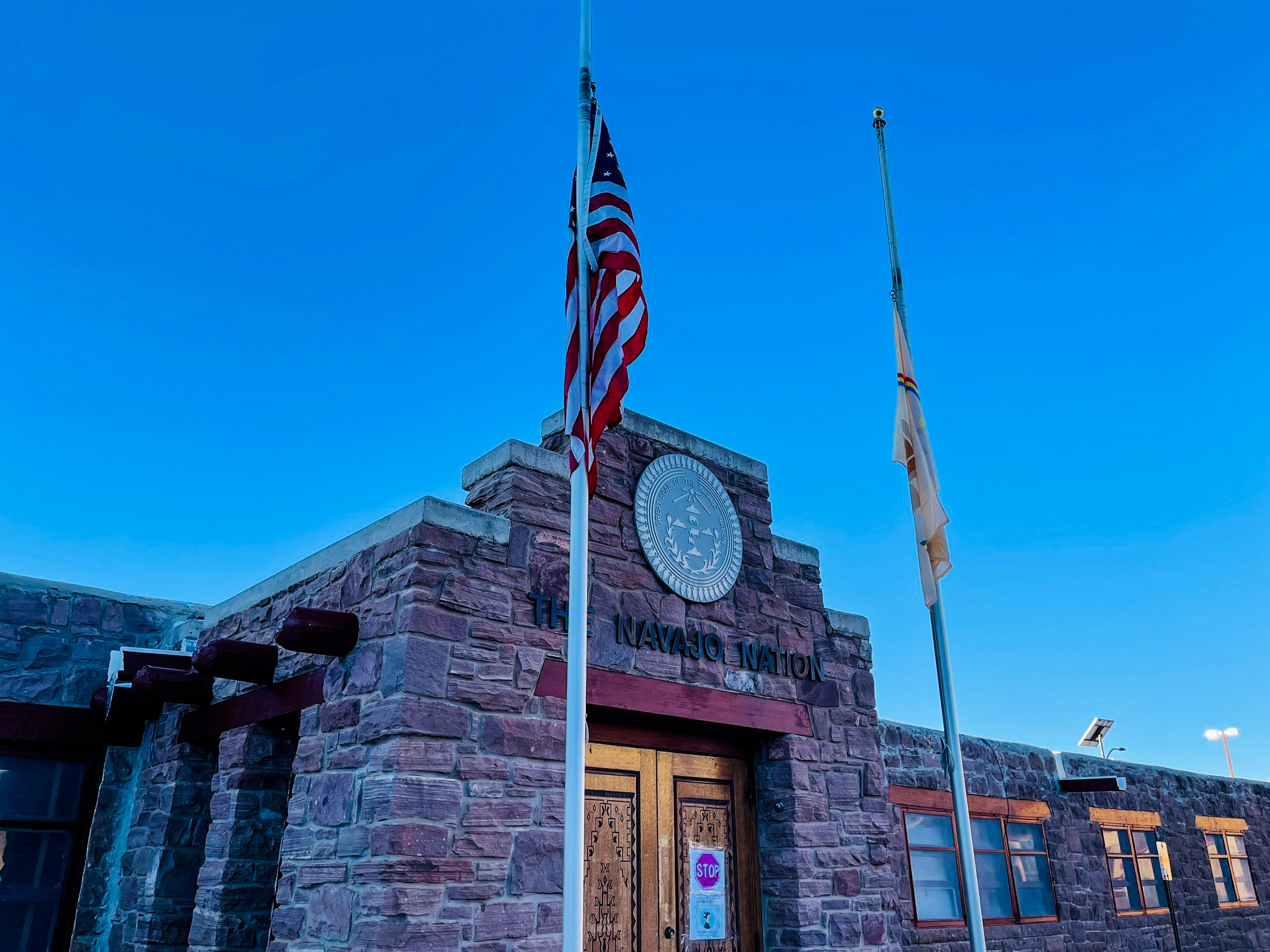
Note: Thumbnail photo of Navajo Nation headquarters in Window Rock, Arizona, by Navajo Nation Office of President and Vice President
COVID-19 Cases by IHS Area
Data are reported from IHS, tribal, and urban Indian organization facilities, though reporting by tribal and urban programs is voluntary. Data reflect cases reported to the IHS through 11:59 pm on January 5, 2022.
|
IHS Area
|
Tested
|
Positive
|
Negative
|
Cumulative
percent
positive |
7-day rolling
average
positivity |
| Alaska |
906,886 |
29,029 |
763,936 |
3.7% |
11.8% |
| Albuquerque |
129,746 |
10,632 |
97,723 |
9.8% |
13.6% |
| Bemidji |
254,418 |
20,709 |
232,959 |
8.2% |
25.6% |
| Billings |
136,935 |
10,303 |
122,742 |
7.7% |
8.6% |
| California |
141,761 |
13,753 |
122,163 |
10.1% |
28.5% |
| Great Plains |
212,024 |
19,569 |
191,713 |
9.3% |
20.7% |
| Nashville |
132,583 |
11,589 |
117,648 |
9.0% |
26.3% |
| Navajo |
395,915 |
47,427 |
289,427 |
14.1% |
21.4% |
| Oklahoma City |
837,450 |
101,555 |
723,556 |
12.3% |
25.8% |
| Phoenix |
253,348 |
33,222 |
218,669 |
13.2% |
26.6% |
| Portland |
188,549 |
13,272 |
174,723 |
7.1% |
22.0% |
| Tucson |
54,702 |
4,551 |
50,028 |
8.3% |
23.6% |
| TOTAL |
3,644,317 |
315,611 |
3,105,287 |
9.2% |
21.7% |
COVID-19 testing data is updated on Mondays and Thursdays.
Source: Indian Health Service (https://www.ihs.gov/coronavirus)