Indianz.Com > News > Tribal leaders urge Congress to protect Native artists from ‘fake tribes’

 YouTube
 Tribal leaders urge Congress to protect Native artists from ‘fake tribes’
Chief of Cherokee Nation leads charge against ‘phony tribes’
Monday, April 17, 2023
Indianz.Com
Efforts to strengthen the Indian Arts and Crafts Act (IACA) are drawing widespread attention as tribes seek a major — and controversial — change to a federal law designed to protect Native artists from frauds.
On Friday, five of the largest Indian Nations in Oklahoma adopted a resolution that calls on the U.S. Congress to restrict the IACA to citizens of federally recognized tribes, meaning those with a government-to-government relationship with the United States. Currently, the law applies to artists from federally and state recognized tribes, allowing them to market and sell their goods as “Indian” made.
But Chief Chuck Hoskin Jr. of the Cherokee Nation is leading the charge against those he refers to as “fake tribes.” He said many of these groups falsely claim to be Cherokee — thus allowing them to market their goods as “Indian” solely based on their status as a state recognized entity.
“This is an offense to our ancestors, an offense to our artists and confusing to art patrons,” Hoskin said in an opinion published on Indianz.Com. “As Chief, I will not tolerate it. So, let’s do something about it. Let’s tell Congress that our ancestors endured too much to allow fake tribes to undermine our culture and lifeways.”

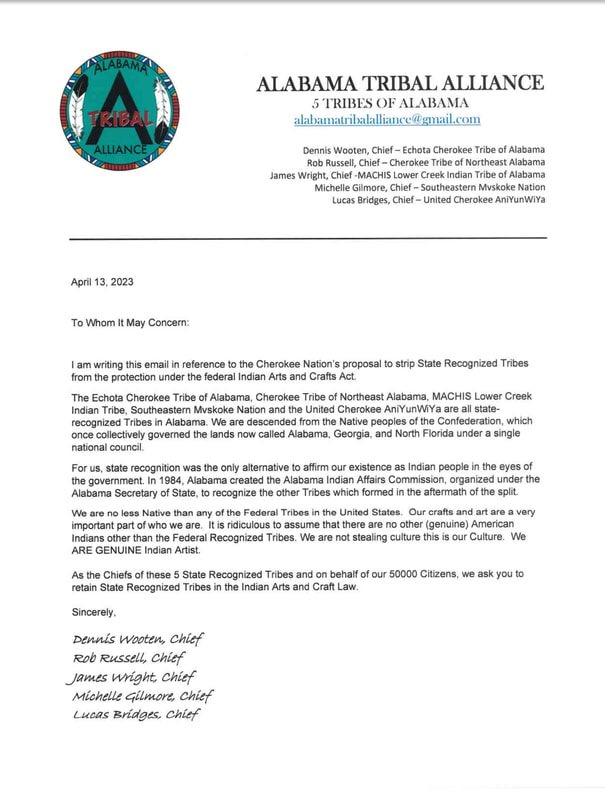
Incidentally, the same artist, who is based in California, challenged another Indian arts law in Missouri with the help of the Pacific Legal Foundation, whose website boasts of a high win rate at the U.S. Supreme Court, where tribes are almost always dealt losses to their rights. The group more recently submitted a brief in Haaland v. Brackeen, the closely-watched case that could lead to ICWA being invalidated for good, depriving federally recognized tribes of the ability to protect their children. When it comes to protecting artists, Congress could resolve the “conflict” that arose in the Oklahoma case by restricting the IACA to citizens of federally recognized tribes. Some state recognized groups are pushing back on the proposal — along with the notion that they are “fake” — as the Senate Committee on Indian Affairs weighs an update to the law. “We are no less Native than any of the Federal Tribes in the United States,” five groups claiming to be “Cherokee” and “Creek” from Alabama wrote in an April 17 letter to the committee. “Our crafts and art are a very important part of who we are. It is ridiculous to assume that there are no other (genuine) American Indians other than the Federal Recognized Tribes. We are not stealing culture this is our Culture.” “We ARE GENUINE Indian Artist,” the letter continues. Chief Hoskin labeled the groups as an “alliance of phony tribes” in a post on social media.The Inter-Tribal Council of the Five Civilized Tribes approved several resolutions, including a resolution supporting the rights of students to wear tribal regalia during graduation ceremonies & a resolution calling on Congress to protect federally recognized Native artists.(2/4) pic.twitter.com/ECC0A75dYE
— Cherokee Nation (@CherokeeNation) April 14, 2023
Amid the jostling, the Senate Committee on Indian Affairs on Friday extended the deadline for comments about potential updates to the IACA. The deadline is now May 19 for what is being called the Amendments to Respect Traditional Indigenous Skill and Talent (ARTIST) Act of 2023. “The ARTIST Act would update the Indian Arts and Crafts Act to support creative economies and strengthen enforcement of current law and protections against counterfeit competition for Native artists and their works,” the Democratic-led committee said in a news release. “Comments will be used to further inform the legislative process and serve as a resource for future discussions on updating the Indian Arts and Crafts Act.” Sen. Brian Schatz (D-Hawaii), the chair of the committee, announced the ARTIST Act as a discussion draft bill on March 14. One of the notable changes [PDF] is the inclusion of Native Hawaiian artists in IACA. As enacted in 1990, the Indian Arts and Crafts Act makes it a crime to market, sell or promote an item as “Indian” unless it was created by a citizen of a state or federally recognized tribe or by an artisan certified by a tribe. The law was written to prevent the historical and ongoing misrepresentation of Native arts by non-Native entities. Native artists and their advocates, however, have long complained about a lack of enforcement — all while fake and fraudulent goods have continued to flood the market. The law was updated in 2000 and in 2010 to address some of the concerns and the ARTIST Act, should it eventually be introduced, could lead to more protections for American Indian, Alaska Native and Native Hawaiian artisans. In addition to extending the deadline for comments, Schatz’s committee announced a listening session for the ARTIST Act on April 26. Details have not yet been made public about the upcoming session, which is set to take place virtually. The Cherokee Nation, meanwhile, is urging its citizens to contact Schatz to limit the IACA to artists from federally recognized tribes. A template letter says such an amendment would protect Cherokee people from “fraudulent and fake artists who illegitimately claim our tribal history and culture.”


Related Stories

Search
Filed Under
Tags
More Headlines
Native America Calling: Persistent heat puts strain on people, the environment, and the economy
Chuck Hoskin: Cherokee Nation creates opportunities close to home
Native America Calling: Increasing hurdles and uncertainty put strains on Native beef producers and farmers
‘Let’s go’: Peggy Flanagan wins Democratic primary for U.S. Senate seat in Minnesota
Native America Calling: Native Playlist with Thomas Michael Swensen and Debora Iyall
Native America Calling: Tribes face record-setting wildfire destruction
NAFOA: 5 Things You Need to Know This Week (August 10, 2026)
Chuck Hoskin: Cherokee Nation invests in tomorrow’s leaders
Native America Calling: August primary elections offer insights on Native candidates’ prospects
Native America Calling: Testing the limits of religious freedom in Indian Country
Native America Calling: When is it OK to let a Native language die?
NAFOA: 5 Things You Need to Know This Week (August 3, 2026)
Chuck Hoskin: Cherokee Nation keeps fiscal promises
Native America Calling: New outbreak of food-borne illness shakes public confidence in food supply
AUDIO: Legislative Hearing to receive testimony on S.3573, S.3617, S.4368, S.4417 & S.4890
More Headlines
Chuck Hoskin: Cherokee Nation creates opportunities close to home
Native America Calling: Increasing hurdles and uncertainty put strains on Native beef producers and farmers
‘Let’s go’: Peggy Flanagan wins Democratic primary for U.S. Senate seat in Minnesota
Native America Calling: Native Playlist with Thomas Michael Swensen and Debora Iyall
Native America Calling: Tribes face record-setting wildfire destruction
NAFOA: 5 Things You Need to Know This Week (August 10, 2026)
Chuck Hoskin: Cherokee Nation invests in tomorrow’s leaders
Native America Calling: August primary elections offer insights on Native candidates’ prospects
Native America Calling: Testing the limits of religious freedom in Indian Country
Native America Calling: When is it OK to let a Native language die?
NAFOA: 5 Things You Need to Know This Week (August 3, 2026)
Chuck Hoskin: Cherokee Nation keeps fiscal promises
Native America Calling: New outbreak of food-borne illness shakes public confidence in food supply
AUDIO: Legislative Hearing to receive testimony on S.3573, S.3617, S.4368, S.4417 & S.4890
More Headlines